
May 13, 2026
zebratech
The Growing Challenge of Getting Insurance Coverage in California: A Guide for Homeowners
A few years ago, most California homeowners barely thought about insurance unless a renewal notice showed up in the mail.Now? Things feel different.People are seeing higher premiums. Stricter inspections. More paperwork. In some cases, even non-renewal notices are sent after years with the same carrier.
And honestly, it feels personal when it happens.
Many homeowners in California are asking the same question right now:
“Why are insurance agents suddenly becoming so selective?”
The answer is not just one thing. It is a combination of wildfire risk, rising rebuilding costs, inflation, climate-related losses, and major changes in how insurers evaluate long-term exposure across the state.
For homeowners in Santa Barbara and throughout California, understanding these changes has become part of protecting a home financially, not just physically.
California’s Insurance Market Has Entered a Different Era
Insurance companies used to focus heavily on past claims history.
Today, they are focused on future risk.
That shift matters more than most people realize.
Modern underwriting models now evaluate things like wildfire patterns, drought conditions, regional catastrophe exposure, rebuilding costs, and even vegetation density surrounding a property.
In other words, insurers are no longer only asking:
“What happened before?”
They are also asking:
“What could happen next?”
That is why even homeowners with clean claims records are facing tougher insurance conversations.
Some carriers have reduced the number of new policies they write in California. Others are reviewing properties much more aggressively before approving or renewing coverage.
For many families, the experience feels confusing at first.
One year, everything looks normal. Then suddenly:
- The premium jumps
- The deductible changes
- An inspection is requested
- or the policy is no longer renewed
That uncertainty creates real stress for homeowners trying to protect what is often their biggest investment.
Wildfire Risk Is Changing Everything
Wildfire exposure has become one of the biggest forces shaping California’s insurance market.
And it is not only homes directly next to forests or mountains anymore.
Insurance companies now use advanced wildfire modeling systems that evaluate:
- brush density
- wind exposure
- terrain conditions
- evacuation accessibility
- nearby fire history
- regional climate trends
Some insurers even use satellite imaging and predictive mapping technology during underwriting reviews.
That means a property considered “moderate risk” by local standards may still trigger concern under an insurer’s internal risk model.
This is one reason many homeowners feel blindsided.
They assume:
“My home has never had a fire claim, so I should be fine.”
But insurers are increasingly evaluating broader geographic exposure, not only individual property history.
That change has reshaped underwriting across California.
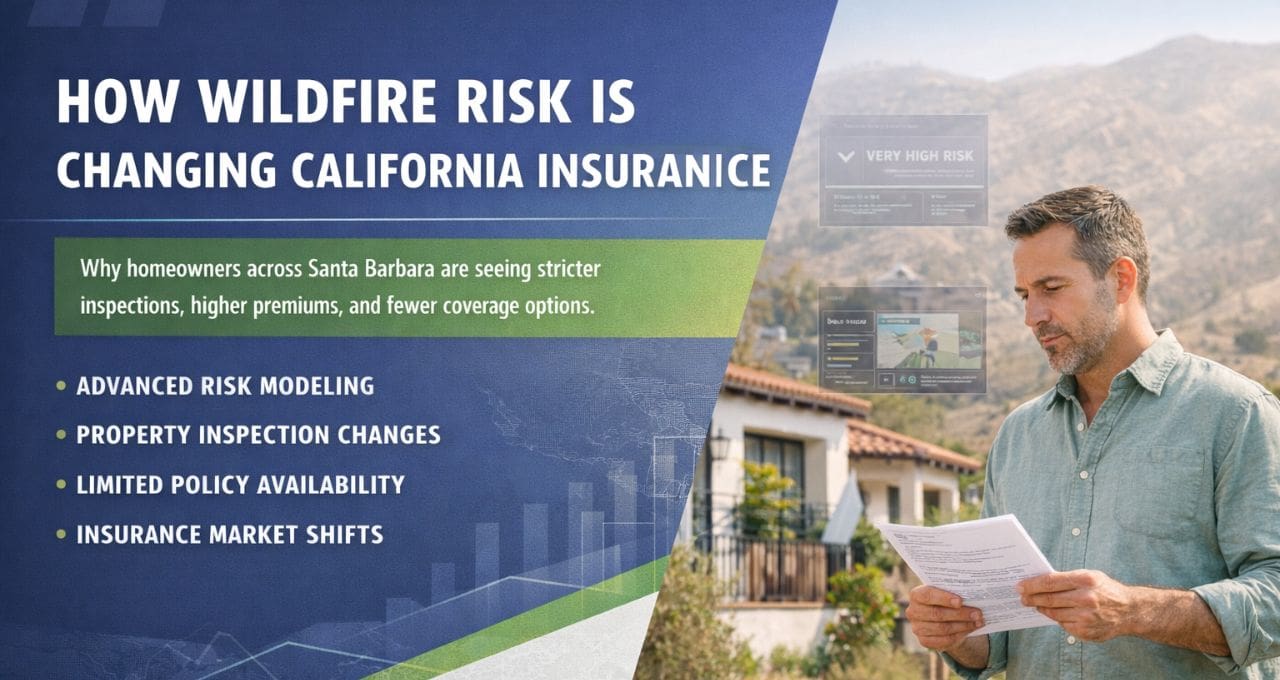
Santa Barbara Homeowners Are Feeling the Impact
Santa Barbara has many features insurers love.
Strong property values. Established neighborhoods. Beautiful coastal communities.
But it also has characteristics insurers now evaluate very carefully.
Foothill neighborhoods, canyon-adjacent properties, dry vegetation zones, and wildfire-prone regions can trigger more detailed underwriting reviews.
Even homeowners farther from wildfire zones are sometimes seeing fewer available coverage options because insurers are trying to reduce total exposure statewide.
That broader pullback has affected many California communities.
And the emotional side of it matters.
People want stability from insurance. They want predictability.
Instead, many homeowners feel uncertain about:
- future premiums
- renewal eligibility
- coverage limitations
- replacement costs
- deductibles
It can feel overwhelming. Especially for families trying to budget carefully in an already expensive housing market.
Why Insurance Companies Are Looking More Closely at Homes
Insurance companies are under pressure to control long-term financial risk.
Recent wildfire losses across California have reached historic levels. Rebuilding costs have also risen sharply because construction labor and materials are significantly more expensive than they were just a few years ago.
Because of that, insurers are paying closer attention to property-level details before offering coverage.
Today, underwriting reviews may include:
- roof age and materials
- electrical system updates
- defensible space around the property
- tree proximity
- siding materials
- prior water or smoke claims
- property maintenance history
Some insurers also evaluate whether homeowners have completed wildfire mitigation improvements.
That part is becoming increasingly important.
California regulators have introduced newer rules encouraging insurers to provide discounts or incentives for wildfire-hardening efforts.
So homeowners who proactively improve their property may have stronger long-term insurance options available.
Why Even Lower-Risk Homes Are Facing Insurance Challenges
This surprises many people.
Insurance challenges are no longer limited to extremely high-risk wildfire areas.
Across California, some insurers are reducing their total policy count statewide. That means even lower-risk homes may experience:
- fewer carrier choices
- stricter underwriting
- longer approval timelines
- rising premiums
The California FAIR Plan has also expanded significantly as more homeowners struggle to secure traditional coverage options.
For many homeowners, this creates a frustrating situation.
They may feel like they are being penalized for broader market problems they did not create.
That reaction is understandable.
But from the insurer’s perspective, the goal is long-term sustainability in a rapidly changing risk environment.
What Homeowners Can Do Right Now
The situation is challenging, but homeowners are not powerless.
In fact, small proactive steps can sometimes improve underwriting outcomes and strengthen future insurability.
Here are several practical areas worth focusing on:
Maintain Your Property Carefully
Insurers notice deferred maintenance.
Updated roofs, electrical systems, plumbing, and exterior improvements can positively affect underwriting reviews.
Improve Wildfire Preparedness
Defensible space and vegetation management matter more today than ever before.
Some insurers specifically review wildfire mitigation efforts during inspections.
Review Coverage Limits Regularly
Construction costs have increased sharply in recent years.
A policy written years ago may no longer reflect realistic rebuilding costs.
Avoid Coverage Gaps
A continuous insurance history can help maintain stronger eligibility with many carriers.
Start Renewal Discussions Early
Waiting until the last minute reduces options.
Starting conversations early creates more flexibility if underwriting challenges arise.
Why Local Guidance from a Reliable Insurance Agent Matters More Than Ever
California’s insurance market has become complicated.
And honestly, most homeowners do not want to spend hours decoding underwriting language or comparing technical policy forms online.
They want clarity.
They want someone who understands:
- Santa Barbara neighborhoods
- California insurance trends
- wildfire-related underwriting concerns
- current carrier availability
That is where local expertise becomes valuable.
A knowledgeable Insurance agent homeowners trust can often identify options, explain underwriting concerns clearly, and help clients avoid common coverage gaps.
That personal guidance matters even more during uncertain market conditions.
Because insurance is no longer just about finding the cheapest premium.
It is about long-term protection.

How Auto and Property Insurance Are Becoming More Connected
Many homeowners are also noticing changes in their vehicle coverage.
That is not a coincidence.
California insurers are increasingly reviewing total customer exposure across both home and vehicle policies. Some carriers are also encouraging policy bundling through larger discounts.
For California residents, this means decisions around Auto Insurance Santa Barbara coverage may influence broader insurance planning strategies as well.
Bundled policies can sometimes improve:
- pricing stability
- discount eligibility
- policy management convenience
- carrier relationship strength
For homeowners balancing property and vehicle coverage together, personalized guidance becomes even more important.
Why Business Owners Are Watching These Changes Too
Even though homeowners are feeling the strongest pressure right now, California businesses are also seeing stricter underwriting standards.
Local companies searching for Business Insurance Santa Barbara coverage are facing more detailed risk reviews related to:
- property exposure
- liability risk
- catastrophe exposure
- operational continuity
This broader tightening across both personal and commercial insurance markets reflects how aggressively insurers are reassessing risk throughout California.
Why Many Santa Barbara Residents Work With CoreGen Insurance Agency, LLC
When insurance markets become more complex, people naturally want trusted guidance.
That is one reason many homeowners turn to CoreGen Insurance Agency, LLC for personalized support.
The agency works closely with Santa Barbara residents to help them:
-
- review existing coverage
- understand underwriting concerns
- navigate changing carrier requirements
- evaluate home and auto insurance strategies together
Clients often appreciate having a real conversation with our seasoned insurance agents in Santa Barbara who understand the local market instead of relying entirely on automated quote systems.
That human side matters.
Especially when insurance decisions start affecting financial stability, property protection, and long-term peace of mind.
Final Thoughts
California’s insurance market is changing quickly.
Underwriting reviews are becoming more detailed. Risk evaluations are becoming more advanced. And homeowners across the state are feeling the impact in very real ways.
But understanding these changes early helps.
The more informed homeowners are about wildfire exposure, underwriting expectations, and evolving coverage trends, the better positioned they become to protect both their property and financial future.
For Santa Barbara residents looking for guidance, CoreGen Insurance Agency, LLC provides personalized support for reviewing coverage options, understanding California insurance changes, and helping homeowners navigate today’s increasingly selective insurance market with greater confidence.